
Best Client Database Software for Small Business in 2026
 Jay
JayEvery small business eventually outgrows the spreadsheet. You start with a Google Sheet tracking client names and emails, then add phone numbers, notes from calls, purchase history, and follow-up dates. Before long, you're managing a mess of tabs and formulas that break when someone accidentally deletes a row.
Client database software solves this by giving your customer data structure, search, and (in most cases) automation. The right tool depends on how many clients you manage, what you need to track, and how much you want to spend.
What to look for in client database software
Before comparing tools, figure out what you need. Most small businesses care about:
Contact management. Storing names, emails, phone numbers, and addresses with the ability to search and filter. This is table stakes.
Interaction tracking. Logging emails, calls, meetings, and notes against each client record. If you forget what you discussed last week, you lose trust.
Custom fields. Every business tracks different things. A law firm needs case numbers. A landscaper needs property sizes. If the tool doesn't let you add custom fields, you'll end up back in a spreadsheet.
Reporting. At minimum, you want to answer questions like "how many new clients did we get this month?" and "which clients haven't been contacted in 90 days?"
Integrations. Does it connect to your email, calendar, and invoicing tool? Manual data entry kills adoption.
Price. For a small business, free or under $30/month per user is the target range. Anything more needs to justify itself with clear ROI.
Best client database software options
1. HubSpot CRM
Best for: Small teams that want a free, full-featured starting point
HubSpot's free CRM covers the basics well. You get contact management, deal tracking, email integration, and basic reporting without paying anything. It's not a stripped-down trial. Up to 2 users can run a client database of up to 1,000 contacts on the free plan.
Key features:
- Up to 1,000 contacts on the free plan
- Email tracking and notifications
- Meeting scheduling
- Live chat widget for your website
- Deal pipeline management
- Mobile app
What you'll pay: Free plan available. Starter plans start at $20/month per seat, add more automation, and remove HubSpot branding. See HubSpot pricing for current rates.
Trade-offs: The free plan caps you at 2 users and 1,000 contacts, and it includes HubSpot branding on forms and chat. Paid plans get expensive fast if you need marketing automation or advanced reporting. The ecosystem is huge, which can feel overwhelming when you're getting started.
2. Zoho CRM
Best for: Businesses that want deep customization without enterprise pricing
Zoho CRM punches above its weight on features. Custom modules, workflow automation, and AI-powered predictions are available at price points that undercut most competitors. Their free plan supports up to 3 users.
Key features:
- Custom fields, modules, and layouts
- Workflow automation rules
- Built-in email client
- Territory management
- Social media integration
- AI assistant (Zia) on paid plans
What you'll pay: Free for up to 3 users. Paid editions start with Starter and are billed per user per month, with a discount for annual billing. See Zoho CRM pricing for current rates.
Trade-offs: The interface feels dated compared to newer tools. Setup takes longer because of the sheer number of options. Mobile experience could be better.
3. Airtable
Best for: Teams that think in spreadsheets but need more power
Airtable sits between a spreadsheet and a database. If your team lives in Google Sheets and resists "real" software, Airtable is the easiest transition. You get the familiar grid view with the structure of a relational database underneath.
Key features:
- Multiple views (grid, kanban, calendar, gallery)
- Rich field types (attachments, checkboxes, linked records)
- Templates for CRM, project tracking, and more
- Automations (send emails, update records, notify Slack)
- API access for custom integrations
What you'll pay: Free for up to 5 editors with 1,000 records per base. Team plan at $20/user/month, billed annually.
Trade-offs: The 1,000-record limit on the free plan is tight. Once you cross it, you're paying $20/user/month with no middle ground. It's flexible, but that flexibility means you're building your own system rather than using one designed for CRM.
4. Freshsales
Best for: Sales teams that live on the phone
Freshsales (by Freshworks) comes with a built-in phone system. You can make and receive calls directly from the CRM, and everything gets logged automatically. For businesses where client relationships depend on phone calls, this removes a huge friction point.
Key features:
- Built-in phone with call recording
- AI-powered lead scoring
- Visual deal pipeline
- Email sequences and templates
- Workflow automation
- 360-degree contact view
What you'll pay: No free plan, but a 21-day free trial. Growth plan at $9/user/month, billed annually. See Freshsales pricing for current rates.
Trade-offs: Freshsales has dropped its free plan, so you pay from day one after the trial. Reporting gets noticeably better at higher tiers, so you may find the cheap plan frustrating.
5. Notion
Best for: Solo operators and tiny teams who want one tool for everything
Notion is a workspace tool, not a CRM. But its database feature is flexible enough to build a solid client tracker. If you're already using Notion for notes, docs, and project management, adding a client database keeps everything in one place.
Key features:
- Databases with custom properties
- Multiple views (table, board, timeline, gallery)
- Templates and formulas
- Relation fields to link databases
- Free for personal use
What you'll pay: Free for personal use. The Plus plan is billed per member per month, with a discount for annual billing. See Notion pricing for current rates.
Trade-offs: No built-in email integration, phone, or sales automation. You're building a database, not using a CRM. Works well up to a few hundred clients, but starts feeling manual at scale.
6. Pipedrive
Best for: Businesses focused on closing deals
Pipedrive is designed around the sales pipeline. Every feature is oriented toward moving deals forward. If your primary goal is tracking leads from first contact to closed deal, Pipedrive's visual pipeline is one of the best in the business.
Key features:
- Visual drag-and-drop pipeline
- Activity-based selling (tasks, calls, emails)
- Email integration with tracking
- Custom fields and filters
- Revenue forecasting
- Mobile app with caller ID
What you'll pay: The entry plan is Lite (formerly Essential), billed per seat per month. No free plan, but a 14-day trial is available. See Pipedrive pricing for current rates.
Trade-offs: No free plan. It's laser-focused on sales, so if you need project management, support tickets, or marketing tools, you'll need additional software.
7. Bitrix24
Best for: Teams that want CRM, tasks, and chat in one platform
Bitrix24 bundles CRM, project management, a website builder, HR tools, and communication features into one product. Its free plan is now pitched at 1-2 users and covers basic CRM (deals and contacts), tasks, calendars, and chat, while sales pipelines and email integration start on paid plans. It tries to be everything, and for small businesses that can't afford multiple subscriptions, that's appealing.
Key features:
- Free plan with basic CRM, tasks, and 5 GB of storage
- Deal and pipeline management
- Task and project management
- Built-in video calls and chat
- Website builder
- Document management
What you'll pay: Free plan for 1-2 users. Basic plan at $49/month for 5 users, billed annually ($69 billed monthly). See Bitrix24 pricing for current rates.
Trade-offs: The interface is cluttered because it does so much. Learning curve is steeper than focused tools. Performance can be slow with large datasets. The jump from free to paid is steep.
8. Build your own with a database tool
Best for: Technical users who want full control over their data
If off-the-shelf CRM software doesn't fit your workflow, or if you want to avoid vendor lock-in, you can build a client database using a database management tool.
Tools like DB Pro let you connect to SQLite, PostgreSQL, MySQL, or other databases and manage your data directly. You design your own tables, write your own queries, and own your data completely.
When this makes sense:
- You have specific data requirements that CRMs don't handle well
- You want to integrate client data with other internal systems
- You're comfortable writing SQL or want to learn
- You need to store more data types than a typical CRM supports (geospatial data, JSON documents, time-series data)
- You want zero monthly per-user fees
Trade-offs: No built-in email automation, pipeline views, or sales features. You're building infrastructure, not using a finished product. Best suited for technically inclined teams.
 DB Pro
Work With Your Databases Like A Pro
Query, explore, and manage your databases with a beautiful desktop app and built-in AI.
Download Now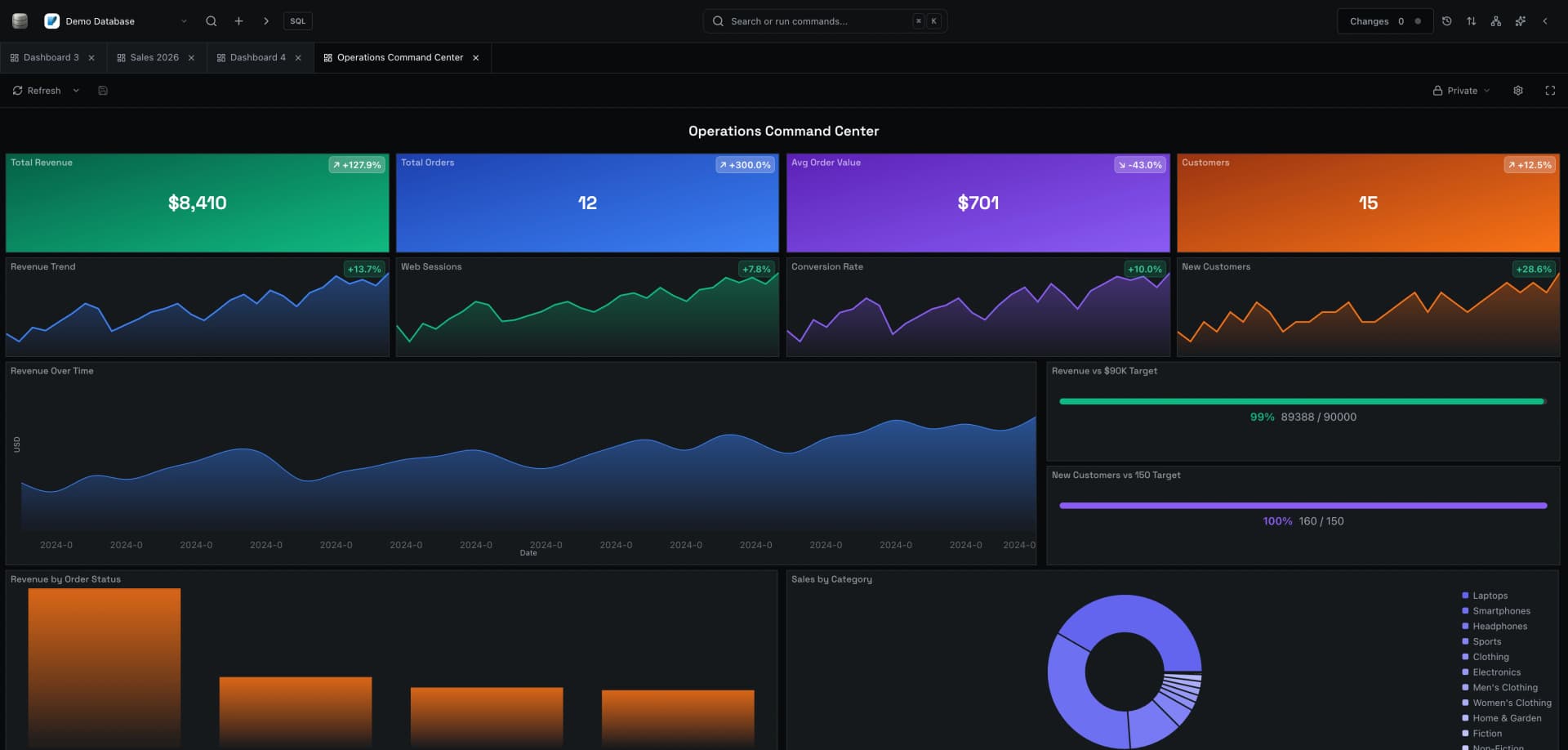
Free client database software comparison
Here's a quick look at what each tool offers on its free plan. Freshsales and Pipedrive are left out because neither has one.
| Tool | Free users | Free contacts | Email integration | Automation | Custom fields |
|---|---|---|---|---|---|
| HubSpot CRM | 2 | 1,000 | Yes | Limited | Yes |
| Zoho CRM | 3 | Limited | Yes | Limited | Yes |
| Airtable | 5 | 1,000 records | No | Limited | Yes |
| Notion | 1 | Unlimited | No | No | Yes |
| Bitrix24 | 1-2 | Basic CRM | No | No | Yes |
How to choose
Start with your team size. If you're a solo founder, Notion or HubSpot's free plan will work fine. For a team of 2, HubSpot gives you the most on the free tier. For 3 people, Zoho CRM's free plan covers you, and Airtable's covers up to 5 editors.
Consider your workflow. Phone-heavy businesses should look at Freshsales. Pipeline-focused teams will like Pipedrive. If you need flexibility and don't mind building your own system, Airtable or a direct database approach gives you the most control.
Think about growth. A tool that's free today but costs $50/user/month when you scale can become a problem fast. Check the pricing tiers before you commit and migrate your data.
Don't over-buy. Most small businesses need contact management, notes, and maybe email tracking. You don't need AI-powered lead scoring when you have 50 clients. Start simple and upgrade when you hit real limitations, not imagined ones.
Moving from spreadsheets
If you're currently running your client database in a spreadsheet, migration is straightforward with most tools:
- Export your spreadsheet as a CSV file
- Map your columns to the new tool's fields
- Import the data (every tool listed here supports CSV import)
- Clean up duplicates after import
- Set up your views (filters, sorts, saved searches)
The hardest part isn't the migration. It's getting your team to stop using the spreadsheet. Pick a cutover date, make the switch, and delete the old spreadsheet (or at least remove edit access) so no one maintains two systems.
Bottom line
For most small businesses, HubSpot CRM is the safest starting point. The free plan is generous, the ecosystem is mature, and you can grow into paid features when you need them.
If HubSpot feels too heavy, Notion works well for solo operators, and Airtable bridges the gap between spreadsheets and databases.
If you need phone integration, Freshsales is the clear winner. If budget is the primary concern and you want CRM, tasks, and chat from one low flat fee, Bitrix24 covers 5 users on its Basic plan.
For technical teams that want full data ownership, connecting directly to a database with a tool like DB Pro gives you the most flexibility with zero per-user costs.
Keep Reading
DB Pro Now Supports Val Town
DB Pro now connects to Val Town's SQLite databases. Browse tables, run queries, and manage your data with a proper desktop client.
Let's Build a Key-Value Database
We build one from an empty file: storage, indexing, crash recovery, and compaction. 193 lines of Python, and it survives being killed mid-write.
Do You Even Need a Database?
We built the same HTTP server in Go, Bun, and Rust using two storage strategies: read the file on every request, or load everything into memory. Then we ran real benchmarks. The results are more interesting than you'd expect.