
ClickHouse vs Druid: Real-Time Analytics Comparison
 Jay
JayClickHouse and Apache Druid both handle real-time analytics on large datasets. They're both columnar, both fast, and both designed for OLAP workloads. But their architectures are fundamentally different, and those differences determine which one fits your use case.
The short version: ClickHouse is simpler to operate and faster for ad-hoc analytical queries. Druid is more complex but better suited for real-time event ingestion with sub-second query latency on high-cardinality data.
Architecture
ClickHouse
ClickHouse is a single, unified system. Each node handles storage, computation, and queries. You add more nodes to scale. Data is stored in a columnar format using the MergeTree engine family, which sorts and compresses data aggressively.
This simplicity is ClickHouse's biggest advantage. You install it, create tables, and start querying. There's one binary, one process type, and one mental model.
In a cluster, ClickHouse uses sharding and replication. You define how data gets distributed across shards, and ClickHouse Keeper (or ZooKeeper) coordinates replication. But each node is architecturally identical.
Druid
Druid splits responsibilities across multiple node types:
- Broker nodes receive queries and coordinate results
- Historical nodes serve completed (immutable) segments
- MiddleManager/Indexer nodes handle real-time ingestion
- Coordinator nodes manage data placement and rebalancing
- Overlord nodes manage ingestion tasks
- Router nodes (optional) route queries to brokers
This separation of concerns means you can scale ingestion independently from queries, and isolate workloads so that a heavy data load doesn't affect query performance.
The trade-off is operational complexity. A minimal Druid cluster runs 4-5 different process types, each with its own configuration, scaling characteristics, and failure modes.
Query performance
Both databases are fast for analytical queries, but they achieve speed differently.
ClickHouse uses a vectorized query engine that processes data in batches (blocks of columns). It's optimized for scanning large amounts of data quickly. Complex aggregations, joins, and multi-table queries are ClickHouse's strength.
For ad-hoc queries across billions of rows, ClickHouse is typically faster. Its query optimizer is more mature, and it supports a wider range of SQL operations including JOINs, subqueries, CTEs, and window functions.
Druid uses a scatter/gather model with heavy indexing. It builds bitmap indexes on dimension columns and partitions data by time. Queries that filter on indexed dimensions and aggregate over time ranges are extremely fast, often returning in under a second.
Druid is optimized for a specific query pattern: filter by dimensions, aggregate by time. If your queries fit this pattern, Druid's sub-second latency is hard to beat. If you need complex joins or ad-hoc exploration, Druid is more limited.
| Query type | ClickHouse | Druid |
|---|---|---|
| Simple aggregations with filters | Fast | Very fast (indexed) |
| Complex multi-table JOINs | Supported, fast | Limited, slower |
| Time-series aggregations | Fast | Very fast (time-partitioned) |
| Ad-hoc exploration | Strong | Weaker |
| Window functions | Full support | Limited support |
| Subqueries and CTEs | Full support | Limited support |
Data ingestion
Real-time ingestion
Druid was designed for real-time event streams from the start. It ingests data through Kafka, Kinesis, or HTTP push, making rows queryable within seconds. Ingestion happens on dedicated nodes, so it doesn't compete with query processing for resources.
ClickHouse supports near-real-time ingestion, but it works best with micro-batches rather than individual row inserts. Inserting rows one at a time into ClickHouse is inefficient because of how the MergeTree engine works. The recommended approach is batching inserts (at least 1,000 rows per batch, ideally more).
For event-driven architectures where data must be queryable immediately after arriving, Druid has the edge.
Batch ingestion
Both handle batch ingestion well. ClickHouse can ingest from files (CSV, Parquet, JSON), S3, Kafka, and other sources. Druid supports similar sources through its indexing service.
ClickHouse's batch ingestion is more straightforward. You run an INSERT query or use the clickhouse-client to load files. Druid requires defining ingestion specs (JSON configurations) that describe the data source, parser, and granularity.
Schema and data model
ClickHouse uses a traditional table schema. You define columns with types, create tables, and alter them as needed. Schema changes are fast and online.
Druid uses a datasource model with three column types:
- Timestamp (required, used for time partitioning)
- Dimensions (strings used for filtering and grouping)
- Metrics (numeric values for aggregation)
This opinionated schema is why Druid is fast for its target workload, but it's restrictive if your data doesn't fit the time-series-with-dimensions model.
 DB Pro
Work With Your Databases Like A Pro
Query, explore, and manage your databases with a beautiful desktop app and built-in AI.
Download Now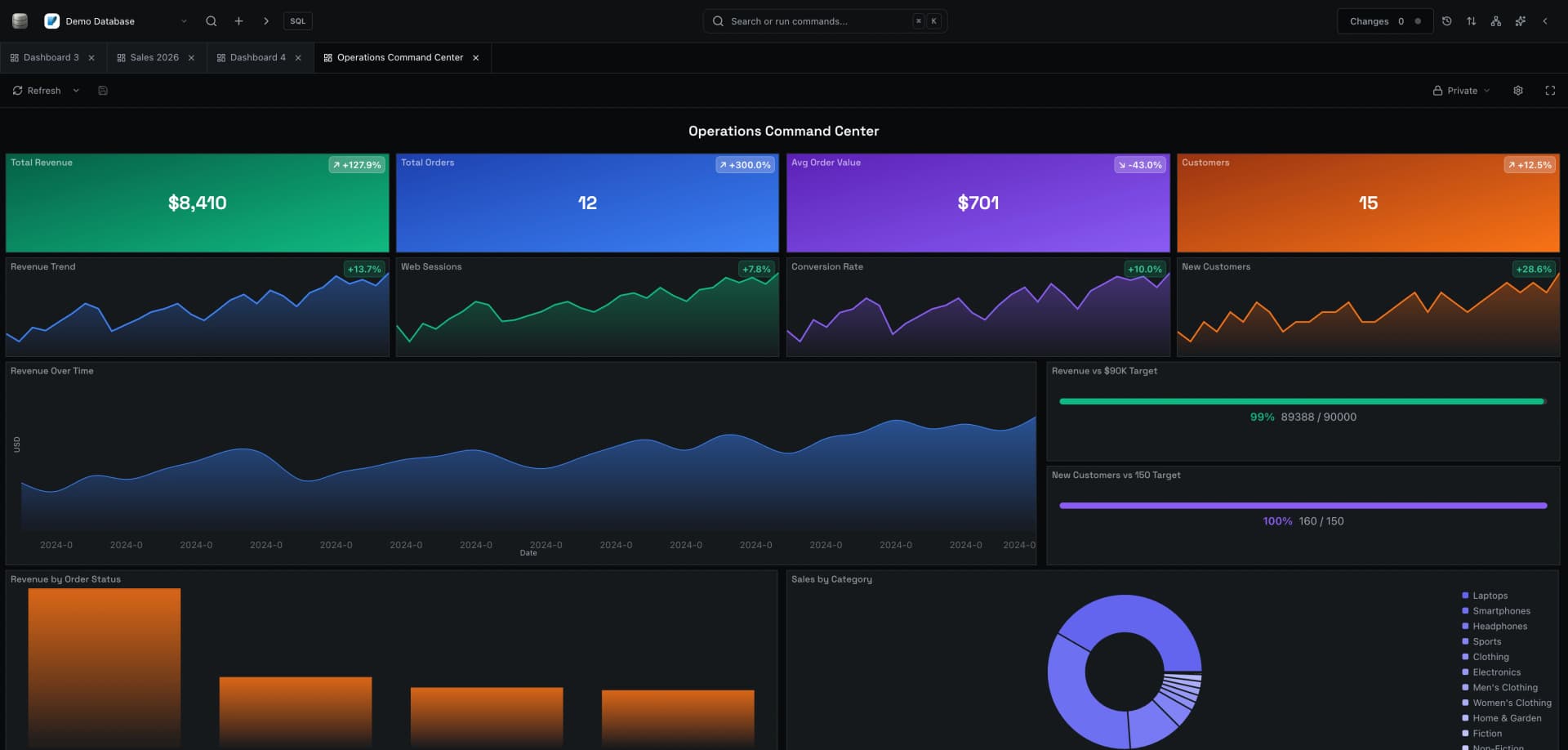
SQL support
ClickHouse has extensive SQL support. It covers most of standard SQL plus many extensions for analytical queries (approximate functions, array operations, probabilistic data structures). You can write complex queries with joins, subqueries, window functions, and CTEs.
Druid added SQL support later, translating SQL queries to its native JSON query language. Coverage has improved significantly, but there are still gaps. Complex joins, certain subquery patterns, and some aggregate functions aren't supported or perform poorly.
If SQL is your primary interface and you need the full range of analytical operations, ClickHouse is the stronger choice.
Operational complexity
This is where the two databases diverge the most.
ClickHouse is operationally simpler:
- Single binary, one process type per node
- Configuration through XML or YAML files
- Built-in system tables for monitoring
- No external dependencies (ClickHouse Keeper is built in)
Druid requires more infrastructure:
- 4-6 different node types to manage
- External ZooKeeper dependency
- Deep storage backend (S3, HDFS, or similar)
- Metadata store (MySQL or PostgreSQL)
- Each node type has different scaling and tuning requirements
For a small team, this complexity matters. Running Druid in production means understanding how each node type behaves, when to scale which component, and how to debug issues across the distributed system.
ClickHouse on Kubernetes with the ClickHouse Operator is relatively straightforward. Druid on Kubernetes works but requires more configuration and operational knowledge.
Storage and cost
ClickHouse stores data locally on each node's disk (SSD or HDD). Compression ratios are excellent, typically 5-10x depending on the data. You can use tiered storage to move older data to cheaper storage (S3-backed) while keeping recent data on fast SSDs.
Druid uses a two-tier storage model. Recent data lives on Historical nodes (local disk), while all data is backed by "deep storage" (typically S3). This means you can retain years of data cheaply in S3 while keeping recent data on fast local storage.
For cost optimization on large datasets with long retention periods, Druid's deep storage model can be cheaper. ClickHouse's tiered storage (available in newer versions) is closing this gap.
Ecosystem and community
ClickHouse has a larger and more active open-source community. It's backed by ClickHouse Inc., which offers ClickHouse Cloud as a managed service. The documentation is extensive, and there's a strong ecosystem of integrations, client libraries, and tools.
Druid is an Apache Software Foundation project. It's backed commercially by Imply, which offers a managed Druid service. The community is smaller but established, with significant adoption at companies like Airbnb, Netflix, and Walmart.
Both have managed cloud offerings if you want to avoid running the infrastructure yourself.
When to choose ClickHouse
- You need a general-purpose analytical database with strong SQL support
- Your team is small and operational simplicity matters
- You need complex queries with joins, window functions, and subqueries
- Ad-hoc query flexibility is important
- You want a simpler deployment (single binary per node)
- Your ingestion can work with micro-batches (even 1-second batches)
When to choose Druid
- You need true real-time ingestion from Kafka or Kinesis with immediate query availability
- Your query pattern is primarily "filter by dimensions, aggregate by time"
- You need workload isolation between ingestion and queries
- You're running a user-facing analytics application where sub-second latency at high concurrency is critical
- You have a large ops team comfortable with distributed systems
- Long-term data retention on cheap storage (S3) is a priority
Feature comparison
| Feature | ClickHouse | Apache Druid |
|---|---|---|
| Architecture | Unified (single node type) | Distributed (5-6 node types) |
| Query engine | Vectorized, batch processing | Scatter/gather, indexed |
| SQL support | Extensive | Growing, some gaps |
| JOINs | Full support | Limited |
| Real-time ingestion | Micro-batch | True real-time |
| Storage | Local disk + tiered | Local + deep storage (S3) |
| Compression | 5-10x typical | 3-8x typical |
| Concurrency | Good (100s of queries/sec) | Very good (1000s of queries/sec) |
| Operational complexity | Lower | Higher |
| Managed cloud options | ClickHouse Cloud | Imply Cloud |
| License | Apache 2.0 | Apache 2.0 |
Bottom line
For most teams evaluating real-time analytics databases, ClickHouse is the better default choice. It's simpler to run, has better SQL support, and handles a wider range of analytical workloads. The gap in real-time ingestion has narrowed as ClickHouse has improved its Kafka integration and batch insertion performance.
Choose Druid when you have a specific use case that aligns with its strengths: true real-time event ingestion, sub-second dashboard queries at high concurrency, or workload isolation requirements that ClickHouse can't match.
If you're exploring either database, tools like DB Pro can help you connect and run queries against ClickHouse directly.
Keep Reading
How to Fix Slow ClickHouse Queries
A practitioner's guide to ClickHouse performance. Primary key design, partition pruning, skip indexes, projections, PREWHERE, materialized views, the join strategies that scale, insert patterns, and the system tables worth knowing.
ClickHouse vs PostgreSQL: OLAP vs OLTP
ClickHouse and PostgreSQL serve different purposes. Here's when to use a columnar analytics database vs a general-purpose relational database.
ClickHouse vs Snowflake: Cost and Performance Comparison
Comparing ClickHouse and Snowflake for analytics workloads. Performance, pricing models, and when each makes sense.