
The Last of the JavaScript Frameworks
 Jay
Jay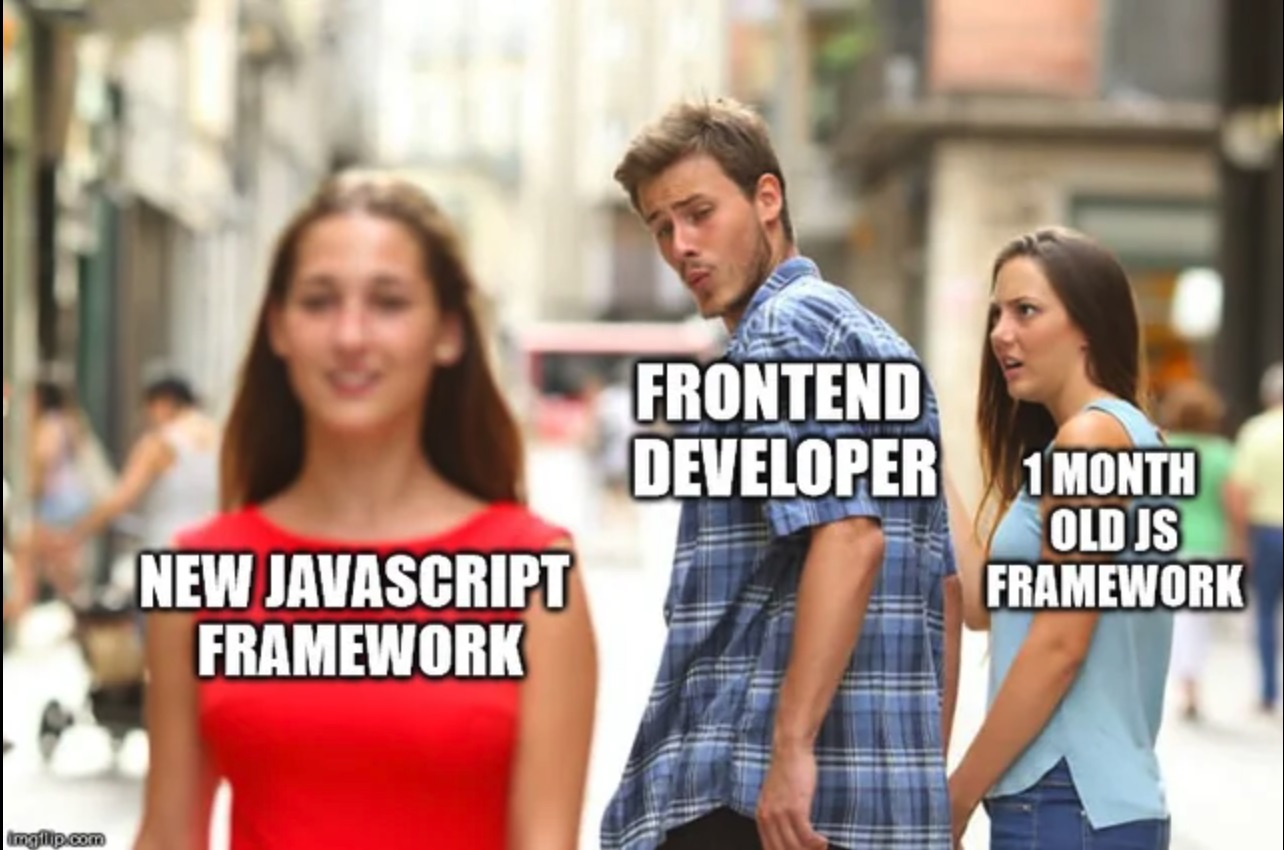
"There's a new JavaScript framework every week."
You know the joke. Everyone knows the joke. For an entire decade, it was the most reliable punchline in all of software engineering.
And it was true. Backbone. Knockout. Ember. Angular. React. Vue. Svelte. Solid. Qwik. Every year brought a new contender. Every year, some developer somewhere decided that the existing options weren't good enough, and that they could do it better. Every Twitter thread, every Hacker News post, every Reddit comment section. The churn was real.
But here's what I noticed recently. The joke doesn't land anymore.
Not because people got tired of it. Because it stopped being accurate.
"JavaScript frameworks been real quiet since LLMs dropped."
Every new framework was designed for a human. A better way to write components. A cleaner mental model. A syntax that felt right in your hands. But humans aren't the ones writing code all day anymore. LLMs are.
ChatGPT launched at the end of 2022. Copilot went mainstream. Cursor showed up. And somewhere in that same window, the JavaScript framework factory shut down. We got through all of 2025 without a single new front-end UI framework. Not one. Sure, new tooling shipped. Build tools, bundlers, runtimes. But nobody stood up and said "here's a new way to build user interfaces." That used to happen every six months.
That's not a coincidence.
The human problem
To understand why the frameworks stopped, you have to understand why they started.
Frameworks were never about the machine. The browser doesn't care if you write React or Vue or vanilla JS. The DOM doesn't have an opinion on JSX versus templates. The V8 engine will run whatever you throw at it.
Frameworks were about the developer.
They existed because humans have preferences. Strong ones. JSX felt natural to some people. Templates felt right to others. Two-way binding made sense to one group while unidirectional data flow made sense to another. Fine-grained reactivity versus virtual DOM diffing. Composition API versus Options API. Every framework was a statement about how a developer should think when building for the web.
These were ergonomic arguments. The code had to feel good to write, because developers were the ones writing it all day, every day. If you spent eight hours a day staring at component syntax, you wanted that syntax to match how your brain worked.
That was the entire motivation. Better DX. A framework that thinks the way you think.
And that motivation made perfect sense. Until the person writing the code stopped being a person.
The machine doesn't care
LLMs don't have syntax preferences.
An AI model doesn't get fatigued reading verbose APIs. It doesn't find JSX more intuitive than templates. It doesn't prefer the Composition API over the Options API. It doesn't care if state management is signals or stores or atoms. These distinctions, the ones that launched a thousand frameworks, are meaningless to a model that processes tokens.
The entire engine that drove framework creation was developer experience. Make it nicer to write. Make it more expressive. Make it feel better.
When a growing percentage of code is being written by AI (with human direction), the definition of "better DX" changes. The developer experience that matters now is the experience of describing what you want and getting correct output. The syntax in between is a detail.
I'm not saying developers have disappeared. Of course not. But the calculus has shifted. Building a new framework used to be a bet: "Enough developers will prefer my way of thinking about components that this thing will achieve critical mass." That bet gets worse every year. Not because developers stopped having opinions. Because opinions about syntax matter less when syntax is increasingly generated, not hand-typed.
The final roster
So let me say it plainly.
No major new JavaScript framework will ship in 2026. Or 2027. Probably not ever again.
What we have now is the final roster. React. Vue. Svelte. Solid. Angular. The meta-frameworks: Next.js, Nuxt, SvelteKit, and Astro. These are the survivors. Not because they're perfect. Not because there's nothing left to improve. But because the conditions that produced their predecessors no longer exist.
The golden age of framework creation required a specific environment: a large population of developers who wrote code by hand all day, who cared intensely about syntax and API design, and who would invest months learning a new tool if it matched their mental model. That environment is eroding.
Existing frameworks will keep evolving. React Server Components, Svelte 5's runes, Solid's fine-grained story. There's still meaningful work happening inside the walls. But new walls aren't going up.
Unless someone builds for the machine
Here's the one scenario I can't rule out. What if someone builds a framework designed not for developers, but for LLMs?
Think about it. React was built for how humans reason about UI. Components, props, state. All mental models that map to how a person thinks about a page. But an LLM doesn't think about pages. It thinks about tokens. What if there was a framework with a smaller syntax surface, fewer ways to express the same thing, and patterns that models can generate with higher accuracy and fewer hallucinations?
Less ambiguity. Fewer footguns. A component model that an LLM gets right on the first try, every time. Not because it feels good to write, but because it's statistically easier to produce correctly.
Nobody has built this yet. Maybe nobody will. But if the next JavaScript framework ever does show up, it won't be because some developer wanted nicer syntax. It'll be because someone optimized for the machine.
The quiet ending
The JavaScript framework wars are over.
Nobody announced it. There was no final battle, no victor's speech. The joke stopped being funny, then it stopped being told, and then one day you realized the silence had been there for a while.
I've been building on the web for a long time. I lived through the churn. I migrated apps from Angular to React, debated Vue versus Svelte, tried every new thing that came along. Part of me is going to miss the chaos.
But if I'm being honest with myself, the thing I'll miss most is the joke.