
Best Postgres GUI Clients in 2026: 7 Options Compared
 Jay
JayThe best Postgres GUI for you depends on what you do all day. If you mostly browse data and write queries, you want something fast and focused. If you administer servers, you want every PostgreSQL feature exposed somewhere in a menu. If you live in an IDE, you want refactoring and code completion that understands your schema.
Here is the short version:
- DB Pro for a fast desktop client that covers Postgres and the other databases you use, with optional AI built in.
- pgAdmin for free, complete PostgreSQL administration.
- DBeaver Community for a free, open source client that connects to almost anything.
- DataGrip for developers who want IDE-grade SQL editing.
- TablePlus for a lightweight native client across many databases.
- Postico for a Mac-only client dedicated to PostgreSQL.
- Navicat for teams that want data modeling, sync, and scheduled jobs in one commercial package.
I work on DB Pro, so weigh that entry accordingly. The others are here because they are good at something, and each section says who should pick it over DB Pro.
Best Postgres GUI comparison
| Tool | Platforms | Licence model | Free option | Best for |
|---|---|---|---|---|
| DB Pro | macOS, Windows, Linux | Free plan; one-time licence or subscription | Free plan with limits | Daily data and query work across databases |
| pgAdmin | macOS, Windows, Linux, browser | Open source (PostgreSQL License) | Fully free | PostgreSQL administration |
| DBeaver | macOS, Windows, Linux | Community is open source (Apache 2.0); PRO editions are annual subscriptions | Community edition | Many databases, zero cost |
| DataGrip | macOS, Windows, Linux | Subscription | Free for non-commercial use | IDE-style SQL development |
| TablePlus | macOS, Windows, Linux, iOS | Perpetual licence with a year of updates | Trial with tab and window limits | Lightweight multi-database client |
| Postico 2 | macOS only | Paid licence | Evaluation with some features disabled | Mac users who only use Postgres |
| Navicat | macOS, Windows, Linux | Perpetual licence or subscription | Navicat Premium Lite | Modeling, sync, and scheduled tasks |
Licence terms change often. I checked each vendor's site on 30 September 2026 and left prices out on purpose; check the vendor before you buy.
What to look for in a Postgres GUI
Postgres type support. A client that treats jsonb, arrays, enums, ranges, and custom types as plain text makes editing painful. Check how each tool displays and edits them before committing.
Query editor quality. Autocomplete that knows your tables and columns, multiple result sets, query history, and a readable EXPLAIN view save the most time.
Safe connections. SSL, SSH tunnels, and credentials stored in the operating system keychain matter for anything outside localhost.
Speed. You open this app dozens of times a day. Start-up time and how it handles a table with a million rows are worth testing yourself.
Scope. A Postgres-only tool can go deeper on PostgreSQL. A multi-database tool saves you from running three apps if you also use MySQL, SQLite, or Redis.
1. DB Pro
DB Pro is a desktop database client for macOS, Windows, and Linux. It is built around the work most developers do with Postgres every day: browsing tables, editing rows, writing SQL, and understanding a schema.
What it does well:
- Data browser. A grid for filtering, sorting, and editing rows inline, with an inspector panel that shows every field, relationship, and piece of metadata for the selected row.
- SQL editor. Schema-aware autocomplete, multiple result sets, saved queries, and an automatic query history you can search and re-run.
- Visual schema explorer. An interactive map of tables and relationships, useful when you join a project with a schema you did not design.
- Postgres types. JSON and JSONB, arrays, and custom types are supported, and enum types appear in the schema tree with their values.
- Connections. SSL/TLS, SSH tunnels, and credentials stored in the system keychain.
- Dashboards. Charts built from queries, for keeping an eye on metrics without a separate BI tool.
- Optional AI. An assistant that writes and explains SQL against your schema. It is off unless you turn it on, you choose whether it sees nothing, the schema only, or schema and data, and you bring your own key for OpenAI, Anthropic, Google, OpenRouter, or Ollama. Requests go straight to that provider.
- More than Postgres. The same app connects to MySQL, MariaDB, SQLite, SQL Server, MongoDB, Redis, ClickHouse, and hosted services such as Supabase, Neon, and PlanetScale.
Trade-offs: DB Pro is a young product compared with the others here. Its focus is daily data and query work, so if you spend your time on server administration tasks, pgAdmin exposes more of PostgreSQL's admin surface. The free plan is limited to two connections and three open tabs, and exports and imports need a paid licence.
Licensing: A free plan with no time limit. Paid options are a one-time Solo licence, which includes one year of updates, or a subscription, plus a Team plan billed per editor. Current prices are on the pricing page.
Choose DB Pro if you want one fast client for Postgres and the other databases you touch, with AI available when you want it and out of the way when you do not.
2. pgAdmin
pgAdmin is the official administration tool of the PostgreSQL community, and it is the most complete free Postgres GUI. Version 9.18 was released on 17 September 2026.
What it does well:
- Coverage. Nearly every PostgreSQL object and setting has a dialog: roles and privileges, tablespaces, publications and subscriptions, foreign data wrappers, and more.
- Admin tools. Backup and restore through
pg_dumpandpg_restore, a Schema Diff tool, an ERD tool, a PL/pgSQL debugger, and a built-in psql tool. - Visual EXPLAIN. A graphical plan view in the query tool.
- AI features. Since version 9.13 (March 2026), pgAdmin includes AI chat in the query tool, AI insights for
EXPLAINplans, and AI reports on security, schema, and performance. You configure your own LLM provider, and administrators can switch the features off. - Server mode. pgAdmin can run as a shared web application for a team.
Trade-offs: pgAdmin is a web application. The desktop version packages the same interface in an app window, and it feels like a web page rather than a native app, particularly when clicking through large trees of objects. It supports PostgreSQL only.
Licensing: Free and open source under the PostgreSQL License.
Choose pgAdmin if you administer PostgreSQL servers and want every option available at no cost. Plenty of people keep pgAdmin installed for admin work and use a different client for daily queries.
3. DBeaver
DBeaver is a universal database client built on the Eclipse platform. Community Edition 26.2.1 was released on 21 September 2026.
What it does well:
- Breadth. Through JDBC drivers, DBeaver connects to a long list of databases, including obscure and legacy ones.
- Features for free. ER diagrams, a data editor, data transfer between databases, an execution plan viewer, and a capable SQL editor are all in the open source edition.
- Basic AI. The Community site lists AI chat and an
@aicommand in the SQL editor. More advanced AI features are reserved for the paid editions.
Trade-offs: DBeaver is a Java application with an interface inherited from Eclipse. It is dense, has many panels and preference screens, and uses more memory than the lighter clients here. Some features, including support for certain NoSQL and cloud databases, are only in the paid PRO editions.
Licensing: DBeaver Community is free and open source under the Apache License. The PRO editions (Lite, Enterprise, Ultimate, and Team) are sold as annual subscriptions that include updates and support.
Choose DBeaver if you need one free tool for many different databases and do not mind a busy interface.
 DB Pro
Work With Your Databases Like A Pro
Query, explore, and manage your databases with a beautiful desktop app and built-in AI.
Download Now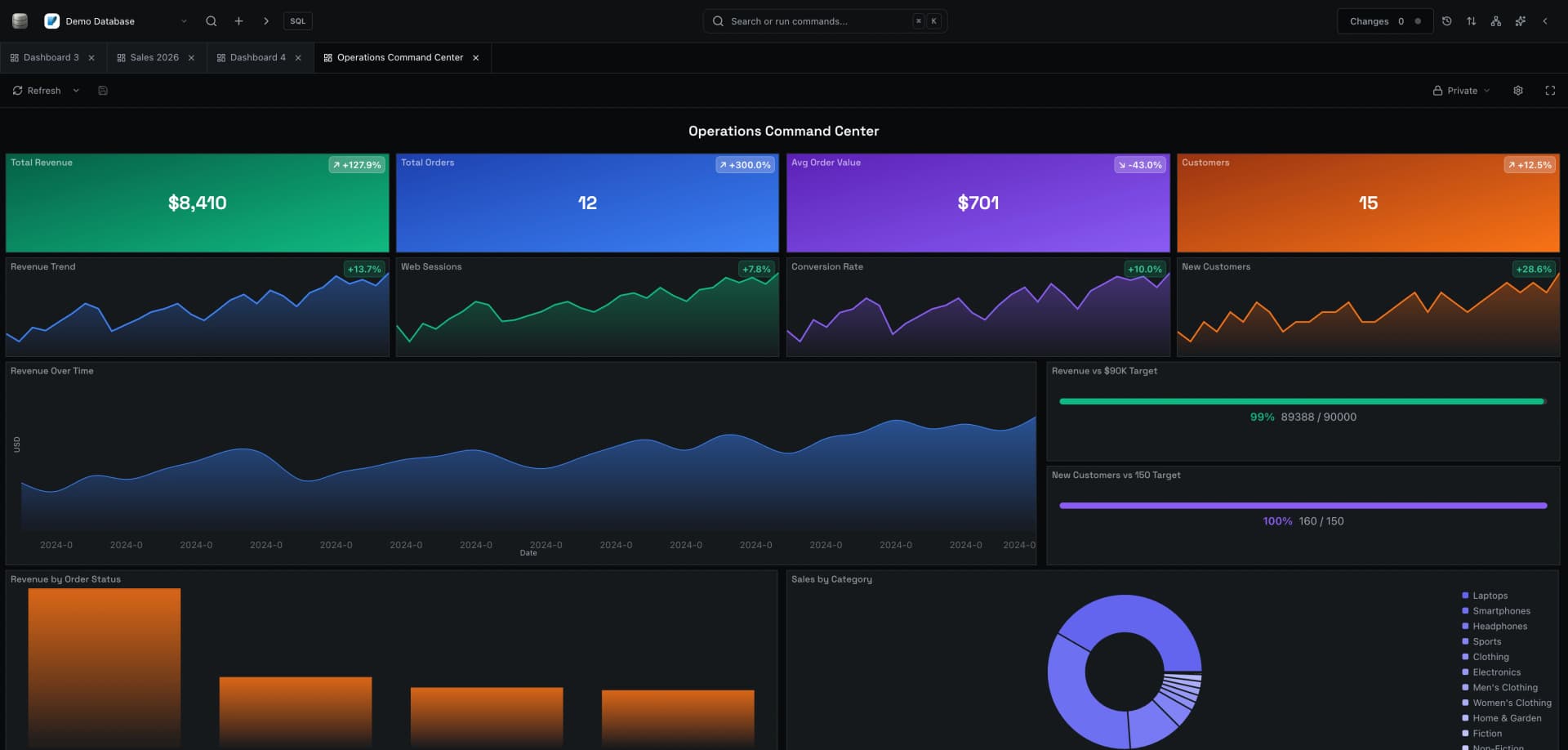
4. DataGrip
DataGrip is JetBrains' database IDE, built on the same platform as IntelliJ IDEA.
What it does well:
- Code intelligence. Autocomplete, inspections, and refactoring that understand your schema, including renaming objects across scripts.
- Scripts as code. Git integration and a file-based workflow for SQL that lives in a repository.
- Consistency with JetBrains IDEs. If you use IntelliJ, PyCharm, or WebStorm, the database tools there share DataGrip's engine.
Trade-offs: It is a full IDE, with the memory use and start-up time that come with one. For opening a table and changing a value, it is more tool than the job needs.
Licensing: Since 1 October 2025, DataGrip has been free for non-commercial use: learning, hobby projects, open source work without commercial benefit, and content creation. The free licence has the same features as the paid one, renews yearly, and requires sending anonymous usage statistics. Commercial use needs a paid subscription, for individuals or organisations.
Choose DataGrip if SQL is a large part of your codebase and you want IDE tooling for it, or if you already pay for JetBrains tools.
5. TablePlus
TablePlus is a native client for many relational and NoSQL databases, known for a clean interface and quick start-up.
What it does well:
- Speed and simplicity. Native apps with a restrained interface. Opening a connection and editing a row takes a few clicks.
- Many databases. PostgreSQL, MySQL, SQLite, SQL Server, Redis, and more from one app.
- Safe editing. Changes are staged and committed explicitly, so a stray edit does not hit the database until you confirm it.
Trade-offs: The free trial is limited to two open tabs, two open windows, and two advanced filters at a time, which is enough to evaluate but not to work in. It has fewer PostgreSQL-specific admin features than pgAdmin.
Licensing: A perpetual licence that includes one year of updates. After that year you keep using the version you have, and renew if you want newer releases. The iOS app is included with a desktop licence.
Choose TablePlus if you want a lightweight, native multi-database client and prefer paying once.
6. Postico 2
Postico 2 is a Mac app dedicated to PostgreSQL. It requires macOS 14 or later.
What it does well:
- Mac-native design. It looks and behaves like a well-made Mac app, which many Mac users value more than a long feature list.
- Postgres focus. Tables, views, functions, and types are presented in PostgreSQL's own terms. It also supports Amazon Redshift, CockroachDB, and Greenplum.
- Clear data editing. Good for people who are comfortable in SQL but want a pleasant way to browse and change data.
Trade-offs: macOS only, and PostgreSQL-family databases only. A team on mixed operating systems cannot standardise on it.
Licensing: A paid licence. The evaluation version has no time limit but disables some features.
Choose Postico if you use a Mac, work only with PostgreSQL, and want the most Mac-like experience.
7. Navicat
Navicat is a long-running commercial database suite. Navicat for PostgreSQL covers Postgres alone; Navicat Premium covers many databases.
What it does well:
- Beyond querying. Data modeling, data and structure synchronisation between databases, data transfer, backups, and scheduled jobs.
- Enterprise features. Collaboration features for sharing connections and queries across a team.
- A free tier. Navicat Premium Lite is free for commercial and non-commercial use, and connects to PostgreSQL, MySQL, SQL Server, Oracle, MariaDB, Snowflake, Redis, and MongoDB with the core features for everyday work.
Trade-offs: The full editions are among the more expensive options here. The interface is dense, and the feature set is larger than most developers need for daily work.
Licensing: Navicat sells both perpetual licences, which include minor updates for the version you bought, and monthly or yearly subscriptions, which always include the latest version.
Choose Navicat if your team needs modeling, synchronisation, and scheduled jobs in one commercial tool with vendor support.
psql is still worth knowing
Whichever GUI you pick, learn psql, the command-line client that ships with PostgreSQL. It is always available on the server, works over any SSH session, and meta-commands like \d, \x, and \timing answer many questions faster than any GUI. The guides on connecting to a database, listing databases, and listing tables cover the commands you will use most.
Which Postgres GUI should you choose?
| If you... | Choose |
|---|---|
| Want a fast client for Postgres and other databases, with optional AI | DB Pro |
| Administer PostgreSQL servers and want everything free | pgAdmin |
| Need one free tool for dozens of database types | DBeaver Community |
| Treat SQL as code and want refactoring and Git | DataGrip |
| Want a lightweight native client and prefer paying once | TablePlus |
| Use only macOS and only PostgreSQL | Postico 2 |
| Need modeling, sync, and scheduled jobs with vendor support | Navicat |
Many developers end up with two: a daily client for data and queries, and pgAdmin or psql for administration. That combination costs nothing extra, since both admin options are free.
Verdict
There is no single best Postgres GUI, but there are clear defaults. For free PostgreSQL administration, pgAdmin is hard to beat, and its 2026 AI features have closed some of the gap with commercial tools. For free multi-database access, DBeaver Community covers the most ground. For heavy SQL development, DataGrip is the strongest editor, and it is now free for non-commercial use.
For daily work across Postgres and the other databases in a typical stack, DB Pro is the one I would pick, which is not a surprise given who wrote this. The free plan is enough to find out whether it suits you. Try two or three of these against your own database before you settle on one, because how a client feels after a week of real use matters more than any feature table.
If you are still setting up Postgres itself, our Postgres in Docker guide gets a local server running in a few minutes, and PostgreSQL vs MySQL covers the choice of engine.
Keep Reading
PostgreSQL vs MySQL: Real Differences, Tested Side by Side
PostgreSQL vs MySQL compared with real output from PostgreSQL 18 and MySQL 8.4: schema changes, type strictness, collations, upserts, JSON, concurrency, licensing, and when to choose each.
Aurora PostgreSQL: Features, Pricing, and When to Use It
A practical breakdown of Amazon Aurora PostgreSQL. What it offers, how its pricing works, and when it's the right choice over standard RDS or self-managed Postgres.
MongoDB vs PostgreSQL: A Detailed Comparison
Comparing the leading NoSQL and SQL databases to help you choose the right one for your project.